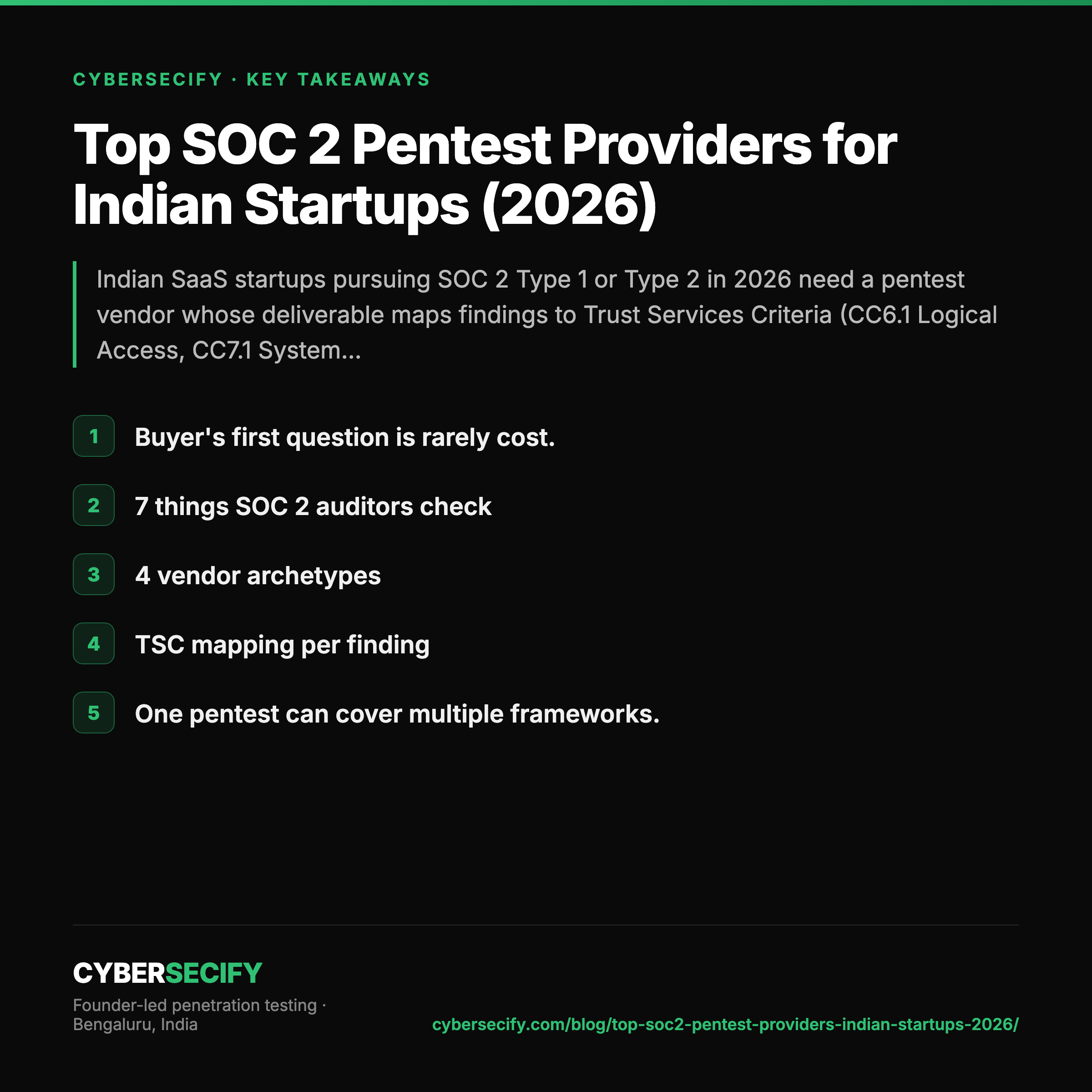
Indian SaaS startups pursuing SOC 2 Type 1 or Type 2 in 2026 need a pentest vendor whose deliverable maps findings to Trust Services Criteria (CC6.1 Logical Access, CC7.1 System Monitoring, etc.), aligns with the audit timeline (8 to 12 weeks pre-audit for Type 1, observation-period-aligned for Type 2), and is recognized by major US and Indian SOC 2 auditors. This guide walks 4 vendor archetypes, the 7 things SOC 2 auditors check in a pentest report, pricing benchmarks per archetype, and how the pentest fits with compliance automation platforms (Vanta, Drata, Sprinto). For founders pursuing SOC 2 Type 1 with a first audit in the next 90 days, Cybersecify Compliance Plan INR 1,79,999 includes TSC mapping and Letter of Attestation in the base price. See the SOC 2 + ISO 27001 ready pentest report sample for the deliverable format auditors expect.
Key findings
- Buyer’s first question is rarely cost. It is “will my SOC 2 auditor accept this pentest report as evidence.” If the report lacks TSC mapping or is a scanner output, the auditor rejects it and the audit clock pauses.
- 7 things SOC 2 auditors check in a pentest report: dated within audit window, independent third-party firm, scope explicitly named, findings mapped to specific Trust Services Criteria, severity rating with rationale, remediation evidence (retest), executive summary the auditor can quote. Independent SOC 2 auditors consistently reject reports that are scanner outputs or that lack TSC mapping.
- 4 vendor archetypes for SOC 2 pentest in India: boutique founder-led firms with TSC mapping included (Cybersecify is one; our published plans are INR 74,999 to 1,79,999), Bangalore-based generalist agencies with audit-prep billed separately (each quoted per engagement), US-headquartered global vendors (quoted per engagement), compliance-platform-recommended partners (Vanta / Drata / Sprinto directories).
- TSC mapping per finding is the differentiator between SOC 2-ready and SOC 2-blind pentest reports. Common Criteria most often mapped from pentest findings: CC6.1 (Logical Access), CC6.6 (Protection Against External Threats), CC6.7 (Data Transmission), CC7.1 (Vulnerability Detection), CC7.2 (Anomaly Monitoring), CC8.1 (Change Management). If the pentest report does not pre-map, the auditor or the founder has to do it manually; it slows the audit.
- One pentest can cover multiple frameworks. SOC 2 + ISO 27001 + DPDP Act mapping in a single report is acceptable evidence for all three audits if the scope covers the relevant surfaces and the report dates align.
- Vanta, Drata, Sprinto each maintain pentest vendor partner directories. A directory listing is a useful shortlist, and the 7 SOC 2 criteria are still the checks to run on whoever you pick from it.
- The boring-but-right answer: for most Indian SaaS startups pursuing first SOC 2 Type 1, a boutique founder-led firm with published pricing and TSC mapping included in the base price, 1 free retest, OSCP-led testing, and a downloadable sample report is the right pick. Cybersecify Compliance Plan fits this profile.
- Sequence matters. Commission the pentest AFTER starting with the compliance platform but BEFORE audit kickoff with the auditor. This aligns the pentest report date with the audit window.
For the SOC 2 pentest we run locally, see penetration testing in Bengaluru.
Cybersecify is a founder-led penetration testing firm based in Bengaluru (Bangalore), India. We pentest SaaS startups preparing for SOC 2 Type 1 and Type 2 audits, across Vanta, Drata, Sprinto, and manual evidence collection. Both co-founders are on every engagement. For the deliverable format SOC 2 auditors expect, see our SOC 2 + ISO 27001 ready pentest report sample.
What SOC 2 auditors actually evaluate
Criterion 1: Report dated within the audit window
For SOC 2 Type 1, the auditor expects the pentest report to be dated within 12 months of the audit period and to cover the production surface as it exists during the audit. For Type 2, the pentest report must cover the observation window (6 to 12 months); auditors expect at least one pentest within the observation period, with additional pentest cycles if the scope changes significantly (new product, major architecture change, new payment integration).
What to avoid: a pentest report dated 14+ months ago. Auditors flag this in the audit findings as stale evidence and may require a fresh pentest before issuing the report.
Criterion 2: Independent third-party firm
The auditor specifically checks that the pentest was issued by an independent third-party firm, not by the development team, not by an internal security team, not by a sister company under the same ownership. The independence is the audit evidence integrity signal.
This rules out: a pentest by your own CTO, by a freelancer working out of your office, by a vendor that is also your development partner. This allows: a pentest by an external firm engaged on a one-time or annual basis, with its own entity, liability cover, and engagement contract.
Criterion 3: Scope explicitly named
The pentest report scope statement must explicitly name what was tested: production web application URLs, API endpoints, payment integration components, authentication and session management, authorization layer (RBAC, multi-tenant), sensitive data flows, cloud configuration (for Type 2). Vague scope statements (“key components,” “main application,” “core functionality”) get flagged by the auditor.
What the auditor compares: the scope statement in the pentest report vs the system description in the SOC 2 audit. If they do not align (pentest covers only the marketing website but the system description includes the full application), the auditor demands a re-scoped pentest.
Criterion 4: Findings mapped to specific Trust Services Criteria
This is the differentiator between SOC 2-ready and SOC 2-blind pentest reports. Each finding in the pentest report should be mapped to specific Trust Services Criteria:
- CC6.1 Logical Access: authentication, authorization, session management, IDOR, multi-tenant boundary findings
- CC6.6 Protection Against External Threats: WAF misconfiguration, missing rate limiting, webhook signature verification gaps, exposed admin interfaces, perimeter access controls
- CC6.7 Data Transmission: TLS misconfiguration, weak ciphers, certificate issues, CORS allow-all in production, secrets exposed in client bundles
- CC7.1 Vulnerability Detection: unpatched dependencies with known CVEs, missing security headers, no documented vulnerability scanning cadence, no third-party pentest
- CC7.2 Anomaly Monitoring: logging gaps, missing alerts on security events, no anomaly detection on authentication or authorization flows
- CC8.1 Change Management: missing security review on deployments, lack of automated security testing in CI, exposed development endpoints reaching production
A pentest report without TSC mapping forces the auditor or the founder to do the mapping manually post-hoc. This slows the audit by 1 to 4 weeks. Cybersecify Compliance Plan INR 1,79,999 includes TSC mapping in the base price.
Criterion 5: Severity rating with rationale
Each finding gets a severity rating (Critical, High, Medium, Low, Informational) with rationale explaining why this severity. Severity should be based on a defensible methodology (CVSS v3.1 or v4.0, OWASP Risk Rating Methodology, or vendor-defined scoring tied to business impact).
Auditors check the severity distribution and look for findings where the severity rationale is inconsistent (a finding rated Low that describes a critical access control bypass) because this signals report quality issues.
Criterion 6: Remediation evidence
A pentest report with open Critical and High findings, no retest, no remediation evidence is incomplete from an audit perspective. The auditor expects:
- Initial pentest report (findings, severity distribution, scope, methodology)
- Founder team remediation log (which findings were fixed, when, by whom)
- Retest report (verification that the fixes worked, residual findings documented and accepted)
Open findings are acceptable if they are documented with a remediation plan and a target close date. Open findings without a plan get flagged.
Cybersecify includes 1 free retest within one month of the v1.0 report on both Essentials and Compliance Plans. Many vendors bill the retest separately. Ask for the retest price in writing before signing, because on a SOC 2 timeline you will almost certainly need one.
Criterion 7: Executive summary the auditor can quote
The executive summary of the pentest report is often quoted directly in the SOC 2 audit System Description. A well-written executive summary:
- States the scope and methodology in 2 to 3 sentences
- Reports the severity distribution
- States the overall security posture (good baseline with X medium findings, vs major gaps in authentication requiring immediate attention)
- States the retest outcome (X findings closed, Y residual findings accepted)
A poorly-written executive summary (1 paragraph of marketing language, no severity distribution, no posture statement) forces the auditor to write their own summary, which is extra audit time and risk.
Vendor archetypes for SOC 2 pentest in India
| Archetype | Pricing range | TSC mapping | Audit recognition | Persona fit |
|---|---|---|---|---|
| Boutique founder-led firm with TSC mapping included (e.g., Cybersecify) | INR 74,999 to 1,79,999 (our published plans) | Included in base price | Accepted by independent SOC 2 auditors when TSC mapping + retest evidence are present | First SOC 2 Type 1 audit, Series A SaaS, 1 to 2 products |
| Bangalore-based generalist agency with audit-prep add-on | Quoted per engagement, audit prep billed separately | Add-on, billed separately | Variable, depends on auditor relationship | Series A to B SaaS with audit-prep budget |
| US-headquartered global vendor | Quoted per engagement | Often included | Familiar to US-based auditors; report formats well-recognized in US audit market | US-anchored SaaS or SaaS with US-based auditor |
| Compliance-platform-recommended pentest partner (Vanta / Drata / Sprinto directory) | Varies by partner, quoted per engagement | Varies by partner | Partnership integration with audit-evidence portal | Vanta / Drata / Sprinto customers wanting integrated workflow |
Very few pentest firms in any of these archetypes publish a rate card, so this table gives a figure only where one can be checked. The boutique figure is our own published price list. Every other archetype, including the US-headquartered global vendor, is quoted per engagement: write one scope, send it to each vendor on your shortlist, and compare the quotes against each other rather than against a number you read online.
Cybersecify works with whichever auditor and compliance platform the customer has already selected.
Cost comparison: SOC 2 Type 1 total cost
For a Series A Indian SaaS pursuing first SOC 2 Type 1 audit:
| Cost component | Range (INR) | Notes |
|---|---|---|
| Compliance automation platform (Vanta / Drata / Sprinto) annual subscription | Quoted per engagement | Verified 2026-08-09: none of the three publishes list pricing. Sprinto bills Indian entities in INR |
| SOC 2 Type 1 audit fee (CPA firm) | Quoted per engagement | No CPA firm publishes a rate card. Get written quotes at your scope |
| Pentest with TSC mapping | 74,999 to 1,79,999 | Our published plan prices. Cybersecify Compliance Plan INR 1,79,999 includes TSC mapping. Other vendors quote per engagement |
| Founder + engineering time for remediation | Variable (200 to 400 hours) | Cost in opportunity terms; founder time is the scarcest resource |
| Total cash cost for first SOC 2 Type 1 | Sum of the three quotes you collect | Excluding internal time |
Underspending on the pentest often means the audit gets delayed or the pentest gets redone, which costs more than spending right the first time.
Decision matrix per scenario
| Scenario | Recommended archetype | Pricing band |
|---|---|---|
| Series A Indian SaaS, first SOC 2 Type 1, India-friendly auditor, Vanta or Sprinto user | Boutique founder-led with TSC mapping included | INR 1,79,999 (Compliance Plan) |
| Series A Indian SaaS, first SOC 2 Type 1, US-based auditor, US-anchored investor preference | Boutique founder-led OR US-headquartered global vendor | INR 1,79,999 (Compliance Plan), or the US vendor’s quote |
| Series B Indian SaaS, SOC 2 Type 2 with observation period in flight | Boutique founder-led with mid-observation re-pentest OR scaled vendor with continuous-monitoring scope | INR 1,79,999 per Compliance Plan engagement with us, two engagements for annual plus mid-cycle; scaled vendors quote per engagement |
| Indian SaaS pursuing SOC 2 + ISO 27001 + DPDP simultaneously | Boutique founder-led with multi-framework mapping included in single report | INR 1,79,999 (Compliance Plan) |
| Indian SaaS in regulated sector (RBI / TRAI / DPDP-specific) requiring SOC 2 + CERT-In | Two engagements: boutique founder-led for SOC 2 + CERT-In empanelled for the regulated component | Compliance Plan INR 1,79,999 for the SOC 2 component; the CERT-In component is quoted per engagement |
| Pre-Series-A Indian SaaS, customer asked for SOC 2 readiness signal but no full audit yet | Essentials Plan tier pentest with SOC 2 readiness mapping appendix | INR 74,999 (Essentials Plan, 1 scope) |
Sharp recommendations
If you are an Indian SaaS founder pursuing first SOC 2 Type 1 audit, pick a pentest vendor that includes Trust Services Criteria mapping in the base price, not as a billable add-on. TSC mapping is the audit-readiness signal that separates SOC 2-ready pentest reports from generic pentest reports. Cybersecify Compliance Plan INR 1,79,999 includes this; many vendors charge separately.
If you are pursuing SOC 2 + ISO 27001 + DPDP simultaneously, do not commission three separate pentest engagements. One pentest with multi-framework mapping in a single report is acceptable evidence for all three audits if the scope covers the relevant surfaces. It costs less than three separate engagements.
If you are tempted by a INR 50,000 pentest quote to save SOC 2 audit cash, the auditor will reject the report. You will redo the pentest at full price. The cheapest option becomes the most expensive plus 2 to 4 weeks of audit delay.
If your compliance platform (Vanta / Drata / Sprinto) recommends a specific pentest vendor from its directory, evaluate that vendor on the 7 SOC 2 auditor criteria above as well as on the recommendation. Ask who will lead the test, what methodology and version they use, whether a retest is included, and whether you can read a sanitized prior report. Those are the same questions to ask any vendor, however you found them.
Do not pentest with your internal team or development partner and submit it as SOC 2 evidence. Auditors check for independence. Internal pentest is a useful baseline but is not SOC 2-acceptable evidence.
Do not skip the retest. SOC 2 auditors expect remediation evidence, not just findings. A pentest with 8 open Critical and High findings, no retest, no remediation log is functionally incomplete from an audit perspective.
Do not commission the pentest before starting with the compliance platform. Sequence: (1) sign up for Vanta / Drata / Sprinto, complete initial integrations, (2) commission the pentest while the platform completes evidence gathering, (3) audit kickoff after both pentest report and platform evidence are in hand. Commissioning the pentest too early dates the report before the audit window.
Where to go from here
If you are pursuing SOC 2 Type 1 with a first audit in the next 90 days and need a pentest report with TSC mapping included, book a free 30-min call. We will walk your stack, recommend Essentials vs Compliance scope, confirm the auditor and the compliance platform you are using, and quote a committed timeline that lands the report before audit kickoff.
For pricing, see Cybersecify Pentest Pricing. For methodology by surface, see our web application pentest service page and API pentest service page. For the deliverable format SOC 2 auditors expect, see our SOC 2 + ISO 27001 ready pentest report sample.
Related
SOC 2 Pentest Requirements: What Auditors Check, SOC 2 Readiness for Indian Startups, SOC 2 Type 1 vs Type 2 for Indian Startups, SOC 2 vs ISO 27001 vs DPDP: Which Compliance First?, Vanta vs Drata vs Secureframe vs Sprinto 2026, Pentest Cost India 2026: Plans + Pricing Guide, How to Evaluate a Pentesting Firm.
How we keep this page current
We review published pages against their sources and update them when something has changed, so what you are reading stays accurate and usable. Each entry below records what changed and when. Some are changes in the source document itself, others are our own corrections. Dates are our review dates, not the source's change date.
- 2026-11-18: Removed the “USD 12K to 30K” band for US-headquartered vendors from the FAQ, the key findings, the archetype table and the table note. It rested on quotes founders have shown us, which no reader can check, and no US vendor in this archetype publishes a rate card that supports it. Those vendors are now described as quoted per engagement, like every other archetype except our own published plans.
- 2026-11-18: Replaced the generalist agency, audit-prep, compliance-platform partner and scenario price bands with a statement that this work is quoted per engagement, because none of them had a published source. Where a scenario is served by our own plans, it now shows our published price. Also removed two percentages derived from those bands: the pentest’s share of total SOC 2 cost, which rested on platform and audit-fee bands removed on 2026-09-04, and a savings figure for combining frameworks.
- 2026-11-17: Removed the INR conversion of the US-headquartered vendor’s USD range. Converting a US price into rupees and placing it in a table of Indian prices implied an Indian market figure that no Indian evidence supports. The USD range is unchanged.
- 2026-09-04: Removed the “6L to 15L” annual subscription band for Vanta, Drata and Sprinto and the claim that Sprinto is the most cost-effective of the three. Verified 2026-08-09: none of them publishes list pricing, so neither the band nor the ranking had anything behind it. Also removed the “4L to 8L” CPA audit fee band and the total derived from both, and labelled the remaining archetype ranges as planning bands rather than market rates.
- 2026-08-09: Reframed how this page described compliance-platform partner directories, and removed a statement about our own listing status that did not accurately describe the position. The advice to evaluate any vendor on the 7 SOC 2 criteria is unchanged, and it applies to how you found the vendor rather than to the directory itself. We work with whichever platform and auditor the customer has already selected.
- 2026-08-09: Removed the unsourced “30 to 50 percent of the original engagement fee” retest pricing figure and the motive attributed to vendors who charge it. The advice to get the retest price in writing before signing is unchanged.